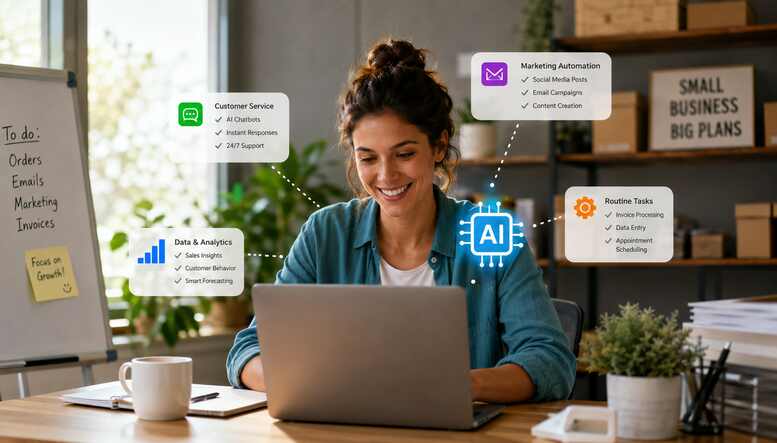
For a small business, time has always been a slightly ridiculous luxury. There are customers to answer, invoices to send, social media posts to prepare, numbers to check and, somewhere between all that, an actual business to run. Hiring another five people would solve plenty of problems. The budget may have other ideas.
This is exactly where artificial intelligence is becoming interesting.
It is no longer only big companies with huge IT teams who can use AI. By 2026, the tools are relatively inexpensive, and they can create marketing content, respond to common customer queries, summarize documents, analyze data and automate repetitive administrative tasks. The Federal Reserve Bank of San Francisco found that almost 40% of small businesses in their survey that were already employing or thinking about using AI were employing it for marketing, customer service, forecasting, and productivity.
Avoid the time-consuming task of marketing and have some fun instead.Don’t waste the whole morning on marketing.
Page Contents
Marketing without spending the whole morning on marketing
Instagram posts are a must for a restaurant. Local retailer requires product descriptions. Newsletters are a consultant’s requirement. Your online shop requires ad copy. In a matter of seconds, AI can generate first drafts of all these.
That’s not to say it’s about clicking a button and publishing whatever appears. There is still a lot of value in humans. Rather than an hour of staring at an empty screen, an owner can get ten ideas as headlines back from an AI tool, rewrite the top two and proceed.
Recent surveys reveal why this is becoming popular. In 2025, 48% of small businesses were already leveraging AI, such as to write emails and social posts, and generate visual content, according to Constant Contact. The move was further in 2026, in fact, with a Goldman Sachs survey revealing that 76% of the small businesses it spoke to were already using AI, with 84% of those using AI business tools reporting that the key benefits were improved efficiency and productivity.
Customer service that doesn’t sleep
Customer service is another obvious opportunity. Many questions businesses receive are wonderfully predictable.
“What time do you close?”
“Where is my order?”
“Can I change my booking?”
“Do you deliver?”
AI-powered chat systems can deal with these repetitive questions while forwarding unusual cases to a human employee. The point is not to build a robot fortress around customers. It is to stop employees answering the same question 37 times on Tuesday.
That can be particularly valuable for online businesses serving customers across different time zones. A small team suddenly has something resembling 24-hour support without actually employing somebody at 3:17 a.m.
PlayBaze and the importance of reducing digital friction
Online platforms offer another useful lesson: customers generally appreciate technology most when it removes unnecessary steps. PlayBaze, for example, emphasizes a straightforward account-access process across desktop and mobile. A returning user can complete the PlayBaze login with the credentials connected to the account and quickly return to the platform. The broader business lesson is simple. Automation works best when customers barely notice it. Whether a company sells games, shoes or accounting services, technology should remove friction rather than create an impressive new collection of buttons.
Let AI dig through the numbers
Analytics sounds like something requiring three monitors, complicated charts and someone saying “quarter-on-quarter” every few minutes. It doesn’t have to.
Small businesses already possess useful information in spreadsheets, accounting systems, ecommerce platforms and customer databases. AI tools can help summarize those numbers and identify patterns.
An owner might ask which products have the strongest margins, which months experience slower demand or which customers have stopped purchasing. AI can also help produce forecasts from historical data, although important financial decisions should still be checked by a human.
This use is becoming increasingly common. The Federal Reserve research specifically identified analytics and forecasting among the ways small firms are applying AI. Meanwhile, a 2026 Bluevine survey found that data analysis had become one of the leading uses of AI among small-business owners. Almost half of businesses using AI in that survey said they were saving at least four hours per week.
Four hours may not sound revolutionary. For a small company, however, that is roughly half a working day returned every week.
Automate the boring stuff first
Perhaps the smartest AI strategy is also the least glamorous.
Start with boring tasks.
Meeting summaries, email drafts, invoice categorization, appointment reminders, data entry, document organization and basic reporting are rarely the reason somebody started a company. Yet collectively they consume an impressive amount of time.
AI combined with workflow automation can handle parts of these processes automatically. A customer inquiry can be categorized, information added to a CRM and a draft response prepared before an employee even opens the message.
The U.S. Chamber of Commerce Foundation reported in June 2026 that half of workers at small businesses were already using AI. Importantly, when AI helped employees complete tasks faster, six in ten said they reinvested that saved time into doing more or better work.
And that may be AI’s biggest advantage for small companies. It doesn’t need to replace the accountant, marketer or customer-service employee. It can simply remove some of the mechanical work surrounding them.
The best small-business AI strategy, then, isn’t particularly futuristic. Find the task everybody hates doing repeatedly. Automate part of it. Measure how much time you saved. Then find the next one.
Do that enough times and suddenly the tiny company starts operating like a considerably bigger one — without acquiring the considerably bigger payroll.
Read More: i love you babe quotes
